La década que está a punto de empezar va a ser muy importante en el campo de la rehabilitación asistida por robots y las ortesis robotizadas. Hace unos años plantearse revisar todo el tema parecía fácil. Hoy hay tantos artículos nuevos y proyectos simultáneamente que la cantidad y calidad abruman, parece como si cada universidad o centro de investigación en rehabilitación importantes tuviera sus propios proyectos. Con que tan solo el 10% de los proyectos en marcha llegaran a ser productos comerciales y de esos solo el 10% llegara a generalizarse podríamos asegurar que el futuro de la rehabilitación contará con tecnología robótica. ¿Qué opinas de ella? ¿qué problemas el ves? ¿qué se puede hacer por mejorarla?.
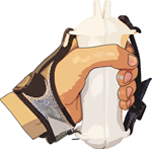
Dos ejemplos The HandSOME y HEXXOR, de la Universidad Católica de América:
The HandSOME
PROJECT DESCRIPTION:
The HandSOME device was designed to compensate for hypertonia after stroke, allowing the stroke patient to regain functional grasp. The device is currently being tested by chronic stroke subjects. The initial findings will be presented at the EMBC in Argentina this summer.
PERSONNEL
E.B. Brokaw, iian Black, and P.S. Lum
FUNDING SOURCE
U.S. Department of Veteran Affairs and U.S. Army Medical Research and Materiel Command
HEXORR robot para rehabilitación de la mano pensado para personas con hemiparesia.
PROJECT DESCRIPTION:
Hemiparetic individuals have great difficulty controlling wrist and hand movements. These impairments can hinder one?s able to perform many typical activities of daily life. This project encompasses the design, development and clinical testing of a robotic exoskeleton for hand therapy. With novel therapy modes, this exoskeleton will help patients increase range of motion, grip strength and overall fine motor control of the hand. Many therapy modes will be investigated to determine an optimal rehabilitation strategy. Potential therapy methods include EMG control and force control. To enhance patient motivation and participation, virtual reality therapy games will be incorporated into therapy sessions. Not only will this exoskeleton be able to provide therapy, it will also serve as an assessment tool. Force and motion sensors will track the progress of each patient's recovery throughout the therapy session. With this exoskeleton, we hope to not only increase hand therapy benefits, but also to collect and analyze quantitative data to gain further incite into this debilitating impairment.
AMADEO es el nombre de este robot para rehabilitación de la mano, una de las principales bazas de esta empresa austriaca: TYROMOTION.
Como puede verse el brazo del paciente se sujeta al dispositivo fácilmente con unas correas de velcro mientras que cada dedo de la mano sostiene una pequeña palanca a la que queda unido por tiras adhesivas.
La máquina es capaz de ofrecer diferentes resistencias a la flexión y extensión de cada dedo a la vez que mide rangos de movimiento y fuerzas que recibe para mostrarlas gráfica y numéricamente.
______________________________
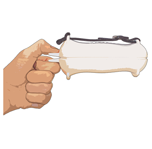
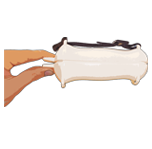
Otro de sus productos se llama PABLO, es un aparato electrónico que puede medir fuerzas en flexión y extensión para diferentes tipos de prensas y pinzas. Como en el caso anterior provee de un feedback audiovisual para el paciente y muestra sus mediciones de manera simple con gráficos para el terapeuta.
La tecnología no desplaza ni elimina el papel del terapeuta ocupacional o fisioterapeuta, aunque permite mayor autonomía del paciente durante la terapia.
Tipos de pinzas y presas cuya fuerza que pueden valorarse con PABLO.
PABLO también permite valorar y registrar rangos de movimiento de varias articulaciones. Tan solo hay que tener el dispositivo en la mano para registrar los movimientos y poder ver los resultados gráficamente en pantalla guardándolos para posteriores evaluaciónes. Útil, ¿verdad?
Flexión del hombro:
Abducción del hombro:
Pronosupinación:
flexoestensión del carpo:
_____________________________
GmbH G-EO-System
El tercer producto interesante de la compañía es este robot para rehabilitación de la marcha, que aún no está comercializado. Sustituye el tapiz rodante habitual por un dispositivo que permite simular la subida de rampas y escaleras. Recuerda bastante al Lokomat de la empresa suiza, Hocoma, pero también al robot alemán para rehabilitación de la marcha Haptic Walker.
_____________________________________
Un par de vídeos hechos por mí mismo con dos productos de la empresa.
El feedback visual es muy sencillo: desde la manguera del camión de bomberos surge un chorro de agua en un recorrido parabólico. Cada una de las cinco casas puede empezar a arder de forma aleatoria. Para que el agua alcance a la casa que necesitamos apagar tenemos que abrir o cerrar la mano, por ejemplo, con la fuerza suficiente. Tienen varias aplicaciones más similares a esta, con manzanas que caen de un árbol, globos aerostáticos, dianas...
Vídeos en Youtube sobre productos de Tyromotion:
________________________
Tyromtion colabora con varios centros españoles en el desarrollo del Rehabilitation Gaming System o RGS, del que ya hemos hablado otras veces (enlace al propio blog). Se trata de un entorno virtual similar a un videojuego que tiene como finalidad motivar al paciente a hacer la terapia mejor.
Stand de la empresa durante el congreso de la Sociedad Internacinal de Rehabilitación Virtual.
Yo mismo con David Ram, ingeniero y copropietario de la empresa, tomando una tercera cerveza en el barrio alemán de Haifa. La tarde-noche fué muy agradable. Nos juntamos un grupo de gente joven, practicamente todos investigadores en diferentes campos punteros y con FUTURO de la rehabilitación: rehabilitación virtual, rehabilitación con robots, neurorehabilitación, rehabilitación neuropsicológica. Todos muy jóvenes y con buena cerveza.
Referencias:
Butefisch C, Hummelsheim H, Denzler P, Mauritz K. Repetitive training of isolated movement improves the outcome of motor rehabilitation of the centrally paretic hand," Journal of the Neurological Sciences, 1995:130, pp. 59-68.
Colombo G, Joerg M, Schreier R, Dietz V. Treadmill training of paraplegic patients with a robotic orthosis," Journal of Rehabilitation Research and Development, 2000:37.
Aisen ML, Krebs HI, Hogan H, McDowell F, Volpe B. The effect of robot assisted therapy and rehabilitative training on motor recovery following stroke," Arch. Neurol., 1997:54, pp. 443-446.
Jack D, Boian R, Merians AS, Tremaine et al., Virtual Reality-Enhanced Stroke Rehabilitation. IEEE Trans Neural System Rehab Eng 2001:9(3), pp 308-318.
Robert J. Sanchez, Jiayin Liu, Sandhya Rao, Punit Shah, Robert Smith, Tariq Rahman, Steven C. Cramer, James E. Bobrow, and David J. Reinkensmeye; “Automating Arm Movement Training Following Severe Stroke: Functional ExercisesWith Quantitative Feedback in a Gravity-Reduced Environment”; IEEE TRANSACTIONS ON NEURAL SYSTEMS AND REHABILITATION ENGINEERING, VOL. 14, NO. 3, SEPTEMBER 2006
Bambi Roberts Brewer; “Visual Feedback Manipulation for Hand Rehabilitation in a Robotic Environment”; CMU-RI-TR-06-24, Doctor Thesis, Carnegie Mellon University, Pittsburgh, PA 15213
S. Hesse, C. Werner, M. Pohl, S. Rueckriem, J. Mehrholz and M.L. Lingnau; „Affected Arm After Stroke: A Single-Blinded Randomized Trial in Two Centers Computerized Arm Training Improves the Motor Control of the Severely”; Stroke 2005;36;1960-1966; originally published online Aug 18, 2005; ISSN: 1524-4628;
Roberto Colombo,, Fabrizio Pisano, Silvestro Micera,, Alessandra Mazzone, Carmen Delconte, M. Chiara Carrozza,, Paolo Dario, Fellow, Giuseppe Minuco; “Robotic Techniques for Upper Limb Evaluation and Rehabilitation of Stroke Patients”; IEEE TRANSACTIONS ON NEURAL SYSTEMS AND REHABILITATION ENGINEERING, VOL. 13, NO. 3, SEPTEMBER 2005 311
Michelle J. Johnson,, H. F. Machiel Van der Loos,, Charles G. Burgar, Peggy Shor, and Larry J. Leifer;” Experimental Results Using Force-Feedback Cueing in Robot-Assisted Stroke Therapy”; IEEE TRANSACTIONS ON NEURAL SYSTEMS AND REHABILITATION ENGINEERING, VOL. 13, NO. 3, SEPTEMBER 2005 335
E.J. Koeneman1, R. S. Schultz1, S.L. Wolf2, D. E. Herring3, J.B. Koeneman1 “A Pneumatic Muscle Hand Therapy Device”
1Kinetic Muscles, Inc, Tempe, AZ, USA
2Dep. of Rehabilitation Medicine, Emory University School of Medicine, Atlanta, GA, USA
3Department of Industrial Design, Arizona State University, Tempe, AZ, USA
K. Kawamura, M. Bishay, S. Bagchi, A. Saad, M. Iskarous, and M. Fumoto; “Intelligent User Interface for a Rehabilitation Robot”; Center for Intelligent Systems, Vanderbilt University Nashville TN 37235
M. Ferraro, J. J. Palazzolo, J. Krol, H. I. Krebs, N. Hogan and B. T. Volpe; “Robot-aided sensorimotor arm training improves outcome in patients with chronic stroke”; Neurology 2003;61;1604-1607
Lum PS, Burgar CG, Shor PC, Majmundar M, Van der Loos M. “Robot-assisted movement training compared with conventional therapy techniques for the rehabilitation of upper limp motor function after stroke”
C. D. Takahashi, L. Der-Yeghiaian, V. Le, R. R. Motiwala, S. C. Cramer; "Robot-based hand motor therapy after stroke"; Brain (2008), 131, 425-437